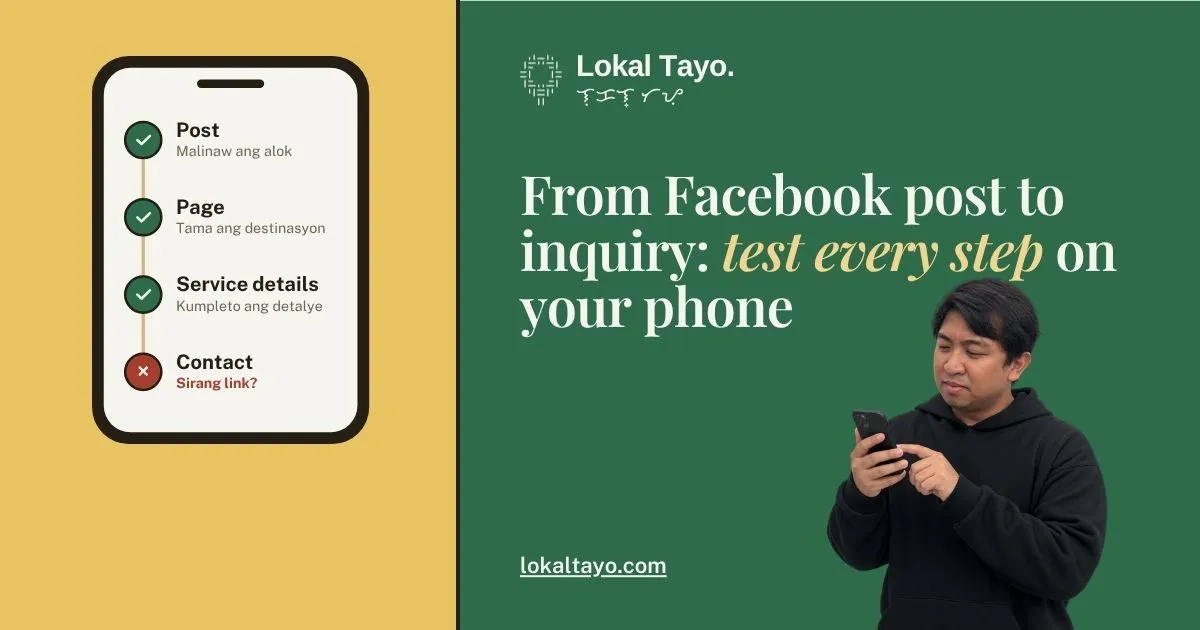
Where does the journey from post to inquiry break?
Choose the closest situation to see which part of the guide to inspect first. You can change your answer at any time.
Quick guide
Three checks before making a change
1Which customer task are you testing?
Pick one post and one intended outcome, such as asking about a specific service. Write that task down before opening the page. Otherwise, it is easy to admire the design without discovering whether a visitor can do what the post suggests.
Use a phone and follow the visible route. Check the destination the visitor actually reaches, rather than assuming the button still points where you originally configured it.
2What should your walkthrough record?
| Step | Question | Finding |
|---|---|---|
| Post | Is the service and promised next step clear? | Record observation |
| Destination | Does it match the post’s promise? | Record observation |
| Information | Are scope, location, and availability understandable? | Record observation |
| Contact | Does the action open the correct route? | Record observation |
| Receipt | Can the responsible person receive the inquiry? | Record observation |
If testing a form, arrange an authorised test and confirm receipt. A success message on the screen does not by itself establish delivery. Record which part you checked and which remains untested.
3Which issue should you fix first?
Start with the first obstacle that stops the task. A broken destination link takes priority over a more attractive cover image. After fixing it, repeat the journey because the next step may reveal a separate problem.
Illustrative exampleNot a client audit
A shop follows an outdated service link
A shop’s post points to a website service page that no longer exists. The owner corrects the link, then discovers the replacement page lacks the shop’s current number. Both need attention; fixing the first link alone would not complete the inquiry route.
What to check
Your worksheet and first action
Mark each check correct, needs attention, or not sure. Your answer stays on this page and is not sent to Lokal Tayo.
This worksheet is a decision aid. Confirm facts with the person responsible for the business before changing public information.
How can you put this into practice?
Use confirmed business information and keep a short record of what you changed and rechecked.
-
Choose one post and customer task.
Choose a specific post and write the task a visitor should complete, such as asking about its advertised service.
-
Follow the complete mobile journey.
Use a phone to follow the destination, information, and contact action; record the first point where the task fails.
-
Confirm the corrected route works.
After correcting the issue, repeat the route and confirm receipt with the responsible person if a form submission is involved.
What is your next step?
Found a break between your Facebook post and the inquiry step?
Talk to Lokal Tayo about a Facebook content plan built around your actual services and customer questions. Start with the part you want to make clearer; agree the work and scope before deciding whether to proceed.
On the contact form, choose “Social media marketing and management”. Share the business name, area, and issue when we get in touch.
The conversation can cover
- Choose one post and customer task.
- Follow the complete mobile journey.
- Confirm the corrected route works.
Frequently asked questions
Can I test from my own account?
You can begin there, but also inspect the public visitor experience where possible. Administration tools and logged-in access can hide problems that ordinary visitors encounter.
Does a successful test prove higher conversion?
It proves the tested route worked under those conditions. Track real visits and received inquiries separately before making claims about conversion changes.
Sources and method
The worksheet and examples in this guide are original editorial tools. They do not claim measured customer results or a surveyed market benchmark.
Prepared from the stated sources where applicable and an original editorial worksheet. No first-hand client test, professional review, or measured conversion improvement is claimed. Examples and numerical illustrations are labelled beside their use.