Which kind of reply needs work?
Choose the closest situation to see which part of the guide to inspect first. You can change your answer at any time.
Quick guide
Three checks before making a change
1What makes a saved reply useful?
A saved reply should answer the question and explain the next step. Personalise it when the inquiry contains details the standard answer does not cover. Sending the same text repeatedly can frustrate someone whose actual question remains unanswered.
Keep a short approved answer sheet. Record who updates it when hours, services, prices, or contact arrangements change. A quick reply is only helpful when its facts are current.
2Which three templates can you adapt?
| Question | Editable reply |
|---|---|
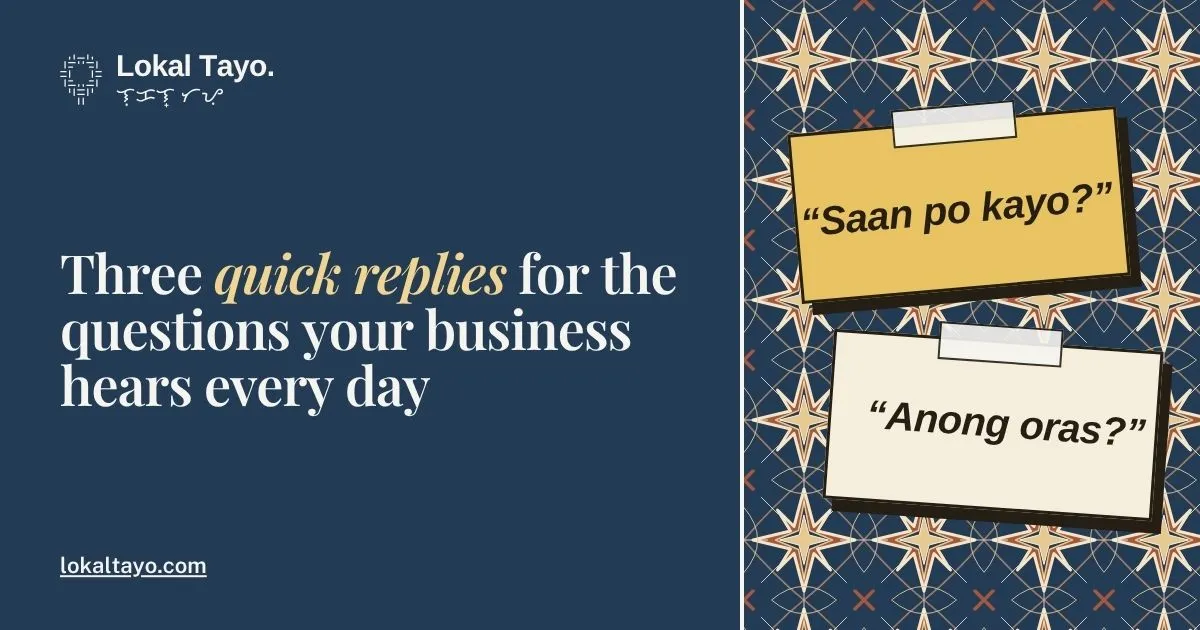
| Where are you? | We’re at [confirmed address]. Look for [accurate entrance detail]. Here are the directions: [tested link]. |
| What time are you open? | Our regular hours are [schedule]. On [affected date], [exception]. For an appointment, please [confirmation step]. |
| Do you offer this service? | We offer [confirmed service and scope]. To check whether we can help with your request, please [appropriate next action]. |
Replace every bracketed field before use. If the answer is uncertain, say you are checking with the responsible person instead of using the nearest available template.
3When should a person take over?
Escalate complaints, unusual requests, changing availability, and questions outside the responder’s authority. The handover should include the question, what has already been said, and who will reply next.
Illustrative exampleNot a client audit
A salon checks service availability
Someone asks whether a salon can accommodate a particular service tomorrow. An hours template answers when the salon opens, but not whether that service is available. The responder checks the schedule and explains how the booking will be confirmed.
What to check
Your worksheet and first action
Mark each check correct, needs attention, or not sure. Your answer stays on this page and is not sent to Lokal Tayo.
This worksheet is a decision aid. Confirm facts with the person responsible for the business before changing public information.
How can you put this into practice?
Use confirmed business information and keep a short record of what you changed and rechecked.
-
Prepare accurate standard answers.
Complete the location, hours, and service responses with approved facts and an appropriate next step for each question.
-
Match the reply to the actual question.
Read the customer's actual request before sending a template, especially where availability or service suitability remains uncertain.
-
Hand over requests needing judgement.
Assign questions outside the responder's authority and note what was already answered so the customer need not start over.
Help with implementation
If replies and published content need a shared plan, discuss the scope of our social media management service. Use the inbox handover guide to identify who answers when the owner is busy.
What is your next step?
Want consistent replies to match the information in your posts?
Talk to Lokal Tayo about a Facebook content plan built around your actual services and customer questions. Start with the part you want to make clearer; agree the work and scope before deciding whether to proceed.
On the contact form, choose “Social media marketing and management”. Share the business name, area, and issue when we get in touch.
The conversation can cover
- Prepare accurate standard answers.
- Match the reply to the actual question.
- Hand over requests needing judgement.
Frequently asked questions
Should a quick reply promise an instant response?
Only describe coverage the business can actually provide. A saved answer can acknowledge receipt, but should not promise that a person is available when the inbox is unattended.
Can I use these replies publicly?
Adapt them to the channel. General hours and directions are suitable public information; personal booking or customer details should go through an appropriate business-controlled route.
Sources and method
The worksheet and examples in this guide are original editorial tools. They do not claim measured customer results or a surveyed market benchmark.
Prepared from the stated sources where applicable and an original editorial worksheet. No first-hand client test, professional review, or measured conversion improvement is claimed. Examples and numerical illustrations are labelled beside their use.